Invoice Requirements for Japan (Cross-Border)
Japan's Qualified Invoice System (since October 2023) lets buyers reclaim Consumption Tax only from registered issuers quoting their registration number; standard JCT is 10%. E-invoicing via Peppol JP PINT is encouraged but not mandatory.
Since 1 October 2023 Japan has operated the Qualified Invoice System for Japanese Consumption Tax (JCT). A buyer can claim input-tax credit only when it holds a qualified invoice from a registered issuer, so the invoice must show the issuer's registration number (a 'T' followed by 13 digits) and break amounts down by tax rate — JCT is 10% standard with an 8% reduced rate on food and some items. There is no clearance mandate: invoices need not be electronic, though structured e-invoicing is promoted through the Peppol JP PINT standard via accredited access points. A transitional measure lets buyers claim a partial credit on purchases from non-registered suppliers (80% to September 2026, then 50% to 2029). Keep invoices for 7 years.
What a compliant invoice issued in Japan must include
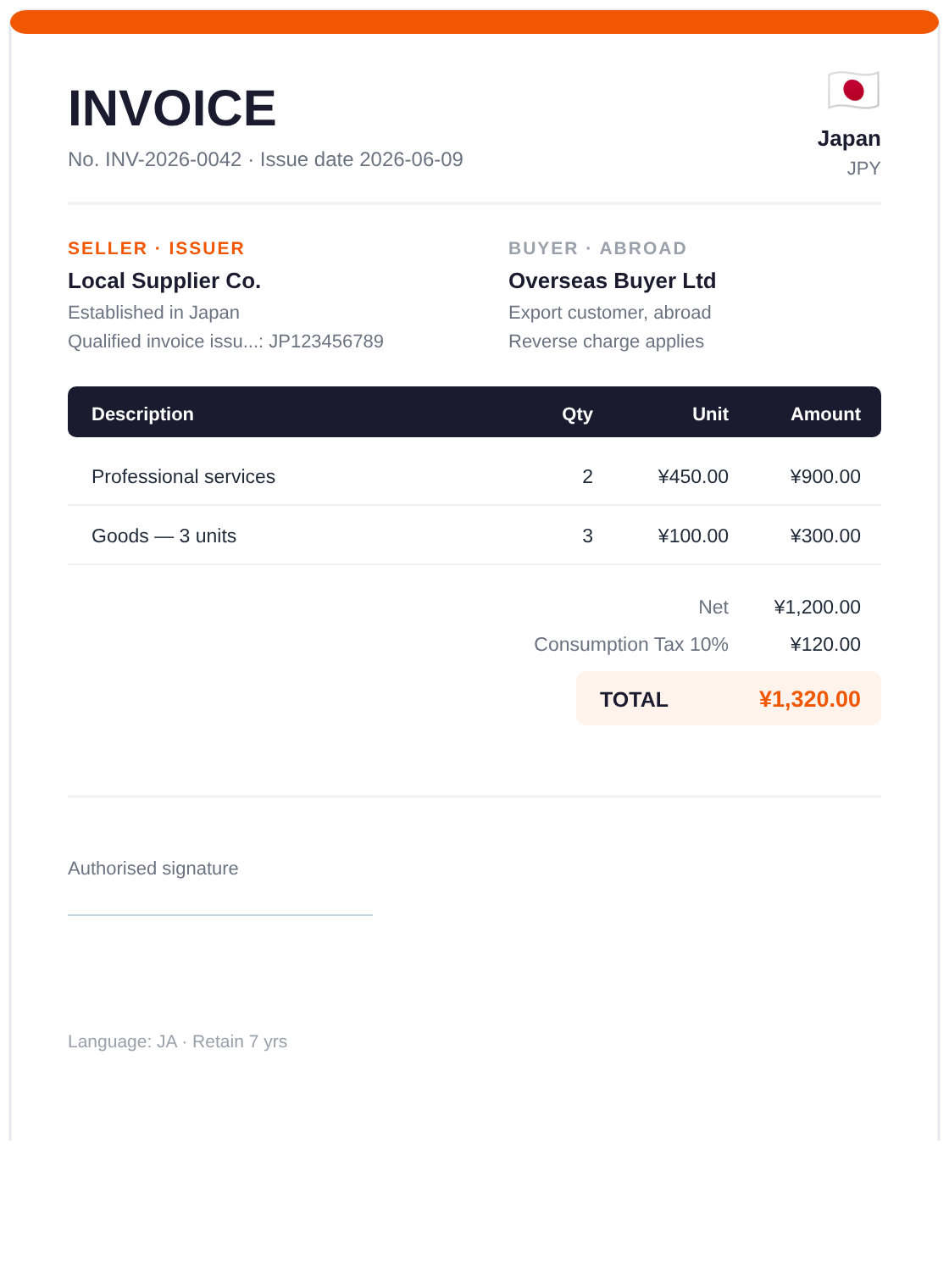
At minimum, an invoice issued in Japan should carry these fields:
Frequently asked questions
What is Japan's Qualified Invoice System?
Since October 2023 a buyer can claim input-tax credit only when it holds a qualified invoice from a registered issuer, so the invoice must show the issuer's registration number (a T followed by 13 digits) and break amounts down by tax rate.
Is e-invoicing mandatory in Japan?
No. There is no clearance mandate and invoices need not be electronic, though structured e-invoicing is promoted through the Peppol JP PINT standard.
What is the Consumption Tax rate in Japan?
10% standard, with an 8% reduced rate on food and some items. Keep invoices for 7 years.
Last reviewed June 9, 2026
At a glance
- Ohmyfin generator
- Available now
- E-invoicing
- Not mandatory
- E-invoicing model
- Post-audit
- Platform
- Peppol (JP PINT) — optional
- Format
- JP PINT (Peppol BIS)
- Tax system
- Consumption Tax
- Standard rate
- 10%
- Tax ID
- Qualified invoice issuer registration number
- Tax ID on invoice
- Required
- Reverse charge (B2B)
- Yes
- Invoice language
- JA
- Local currency required
- No
- Keep records for
- 7 years
- Customs invoice (goods)
- Yes
- Complexity
- Medium
Example: an invoice issued in Japan
Create a compliant Japan invoice in minutes
Skip the rulebook. Our generator applies these requirements automatically — the right fields, tax-ID labels, language and format for the destination country.
Open the invoice generator Browse other countriesThis page is general information on cross-border invoicing, not tax or legal advice. Rules change and depend on your specific transaction — confirm with a qualified adviser or the local tax authority before relying on it.