An invoice to a customer in your own country answers questions everybody there already agrees on. An invoice to a customer abroad adds four that the seller has to answer alone: which language it is written in, which country's VAT applies and what the invoice has to say about it, whether the buyer is someone the seller may deal with at all, and whether the goods may go where they are going. Below are the rules that answer each one, with five sample invoices. The companies on them are fictional. The PDFs are real documents: the text can be searched and copied, and the four German ones carry their e-invoice inside the file.
- A UK consultancy invoicing a German company for services (English, reverse charge)
- A German down payment invoice (Anzahlungsrechnung)
- The final invoice after that down payment (Schlussrechnung)
- A correction of that final invoice (Rechnungskorrektur)
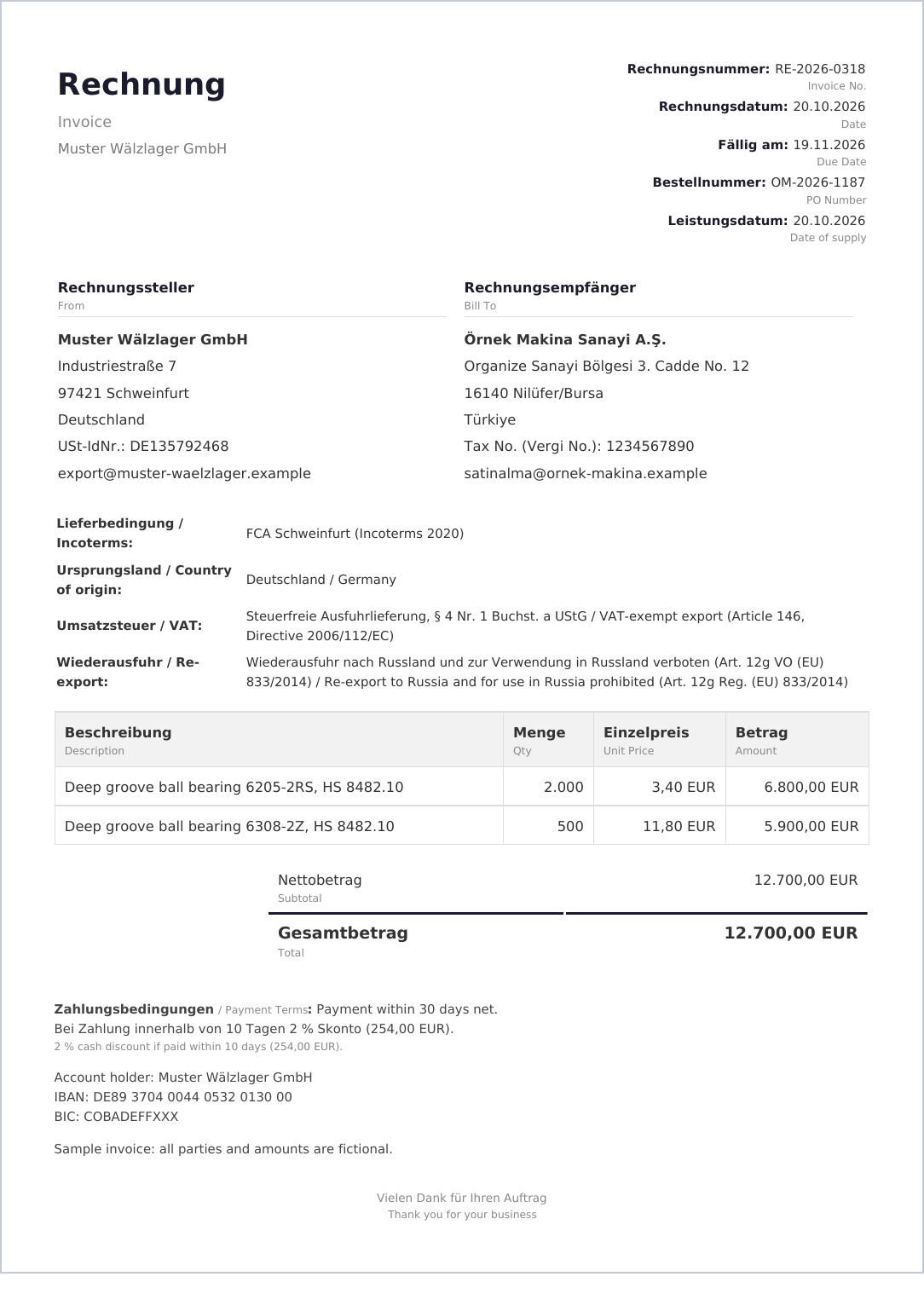
- A German export invoice to Turkey with a cash discount (German and English, Skonto)
Which language the invoice must be in
The usual assumption is that the buyer's country decides. In the rules we read, it does not. EU VAT law prescribes no language for an invoice. A member state may ask for a translation "for control purposes", and the European Commission's notes on the invoicing rules say that a member state "must not restrict the right of deduction only because of the language used". The EU Court of Justice went further in 2016: a Belgian regional law that made invoices void unless they were written in Dutch was a restriction on the free movement of goods that the law could not justify (case C-15/15, New Valmar).
| Where | What the rule says | Who must act |
|---|---|---|
| EU VAT law | No language prescribed; a translation may be requested in an audit | Whoever is audited, if asked |
| Germany | German is the official language and the tax office may ask for a translation. The statutory wording may be given in any EU language, so "Reverse charge" counts | Whoever is audited, if asked |
| France | The French language law lists invoices, but its implementing circular leaves out invoices between businesses | A seller to consumers |
| Poland | Polish for consumers in Poland and where a public body is a party | A seller to consumers or public bodies |
| United States | Invoices for imported goods in English, or with an English translation | The importer |
| Saudi Arabia | Arabic, alongside any other language, for a Saudi VAT-registered seller | The Saudi seller |
France and Poland protect consumers in their own language. Between businesses, where a language is required at all, the duty sits with the seller's own country, as in Saudi Arabia, or with the customs import, as in the United States. The buyer's tax office can ask for a translation when it audits, and that is all. So the seller's language with English beside it covers both sides: the seller's language for the seller's own books and auditor, English for the buyer and for customs. The export sample works that way, with every heading in German and the English under it. A UK seller writes English and is done (UK sample).
Whose VAT applies, and the sentence the invoice must carry
Services between businesses are taxed where the customer is established (VAT Directive, Article 44). When the supplier is not established in that country, the customer pays the VAT itself (Article 196). The supplier's invoice then shows no VAT and has to say why, with the words "Reverse charge" (Article 226, point 11a).
The UK sample is a London consultancy billing a Hamburg logistics company for twelve days of work. HMRC treats the supply as made where the customer belongs, so it is outside the scope of UK VAT (VAT Notice 741A, sections 2.1 and 6.3). In Germany the Hamburg company owes the VAT (§ 13b UStG, paragraph 2 number 1 and paragraph 5), and German law asks the invoice to say "Steuerschuldnerschaft des Leistungsempfängers" (§ 14a paragraph 5 UStG). Since a letter of the Federal Ministry of Finance of 17 September 2025, the English wording of the same EU article does the job, so the sample says "Reverse charge" and nothing in German.
Goods are different. A sale of goods to a business in another EU country is an exempt intra-Community supply, and in Germany the invoice must carry both parties' VAT numbers and be issued by the 15th of the following month (§ 14a paragraph 3 UStG). Goods leaving the EU are an exempt export (Article 146), and the invoice must name the exemption it relies on (Article 226, point 11). The export sample does both in one line: "Steuerfreie Ausfuhrlieferung, § 4 Nr. 1 Buchst. a UStG", with the English after it.
Germany from 2027: the e-invoice, and three documents that change with it
In Germany an e-invoice is an invoice issued, sent and received in a structured format that follows the European standard for e-invoicing, EN 16931 (§ 14 paragraph 1 UStG). A PDF is not one. Between two businesses established in Germany, invoices must be e-invoices, with a transition: paper, or a PDF if the buyer agrees, remains allowed for supplies made until the end of 2026, and during 2027 only for sellers whose turnover in the previous year was at most 800,000 euros (§ 27 paragraph 38 UStG). An invoice to a buyer abroad is outside this rule. The EU's own version arrives later: its digital reporting requirements reach cross-border trade between businesses on 1 July 2030 (Directive (EU) 2025/516).
A ZUGFeRD invoice, one of the two formats used in Germany, is a PDF for people to read with the XML file, which is the actual invoice, attached inside it. The four German samples are made that way. Open one in a PDF reader and look at its attachments: the file factur-x.xml is the e-invoice, and it passes the validator published by the German public sector's coordination office for IT standards, KoSIT.
On 15 October 2026 the Federal Ministry of Finance published further rules for e-invoices. They apply to e-invoices issued from 1 January 2027; until then an e-invoice that meets only the earlier letters is not objected to. Three of them change documents every German business already issues.
Down payment and final invoice
A final invoice states the full price and the full VAT, and then deducts the down payments received with the VAT on them (§ 14 paragraph 5 UStG). In the XML the letter allows the deductions as one sum in the field for amounts already paid, with the details in a note, a rule it accepts until 30 June 2030. The familiar shortcut of entering the down payment as a negative line does not survive: the European standard does not allow a negative item price, so the validator rejects the file, and the invoice would also state less VAT than the supply carries. The down payment invoice asks for 10,000.00 euros plus 1,900.00 VAT. The final invoice states 50,000.00 plus 9,500.00 VAT, deducts the 11,900.00 received, and asks for 47,600.00.
Corrections
A correction of an e-invoice is itself an e-invoice, of the correction type, and the original and the correction together must state the final facts, with a specific and unambiguous reference to the original. In the correction sample the hall measured 1,920 square metres, not the 2,000 billed. The corrected invoice names the invoice it corrects, says it replaces it in full, and restates everything: 48,000.00 plus 9,120.00 VAT, less the same down payment, 45,220.00 to pay.
Skonto
Any reduction agreed in advance, a cash discount for early payment included, has to be on the invoice (§ 14 paragraph 4 number 7 UStG), and the letter repeats this for e-invoices. A sentence in the payment terms is written for people. XRechnung, the German version of the standard, defines a line for software to read: #SKONTO#TAGE=10#PROZENT=2.00# for 2 % within 10 days. The export sample carries that line in its XML and the sentence on the page: 2 % within 10 days, 254.00 euros on 12,700.00.
Who is on the other side of the invoice
EU sanctions law freezes what listed persons own and adds: "No funds or economic resources shall be made available, directly or indirectly, to or for the benefit of" them (Regulation (EU) No 269/2014, Article 2(2)). Delivering goods to a listed buyer makes economic resources available to it. Paying a listed supplier makes funds available. The invoice is the one document that names both parties with everything needed to check them: legal name, address, VAT or registration number. Lists change between one invoice and the next, so the check that counts is the one made when the invoice is issued, not the one made when the customer was taken on. A name can be checked against the lists on our screening page.
A company on no list can still be caught. Under the US 50 Percent Rule, a company owned 50 percent or more, directly or indirectly, in the aggregate, by blocked persons is itself blocked (OFAC FAQ 402). The EU applies a similar ownership and control test through the Council's guidance on implementing sanctions, updated in July 2024 to the same 50 percent threshold (Akin Gump's summary). So the name on the invoice is where the check starts, not where it ends.
Where the goods may go
Export controls follow the goods, and the goods are identified by their HS code. Dual-use items, those listed in Annex I of Regulation (EU) 2021/821, need a licence to leave the EU. For Russia there is a second list. The European Commission publishes the common high priority items, 50 six-digit HS codes agreed with the United States, the United Kingdom and Japan, from microchips to ball bearings. An EU exporter selling any of them to a buyer outside the partner countries (the United States, the United Kingdom, Japan, South Korea, Australia, Canada, New Zealand, Norway, Switzerland, Iceland and Liechtenstein) must put a clause in the contract that prohibits re-export to Russia and for use in Russia, a duty in force since 20 March 2024, and since 26 December 2024 must also have due diligence in place for such sales (Regulation (EU) No 833/2014, Articles 12g and 12gb).
The export sample is a Schweinfurt bearings maker selling 2,500 deep groove ball bearings, HS 8482.10, to a machine builder in Bursa. Ball bearings are on the list, and Turkey is not a partner country, so the contract needs the clause. The law asks for it in the contract, not on the invoice. The sample repeats it on the invoice anyway, beside the HS code it applies to, where everyone who handles the shipment will see it.
How the samples were made
The five samples were made with Ohmyfin's own invoice generator, which handles each step above for one invoice: it decides the language (the seller's, with English beside it when the buyer is abroad), states the VAT treatment the two countries call for, screens both parties against sanctions lists and checks trade restrictions before the invoice is issued, and for a German seller writes down payment, final, correction and Skonto invoices with the e-invoice inside the PDF. In the invoice generator you describe the invoice to Ohm, our assistant, in your own words and receive the PDF by email. From your own AI agent, the issue_invoice tool on our MCP server issues the same invoice in one call. The rules it works from, country by country, are on our invoice requirements pages.