Before re-sending a stuck payment, it usually helps to understand the payment route: the intermediary (correspondent) banks that sit between the sender's bank and the beneficiary's bank. Knowing which institutions the funds pass through is often the key to explaining where a transfer is being held and why it is delayed.
At Ohmyfin we rebuild this potential route from SSI, the Standard Settlement Instructions that banks maintain with each other for a given currency. This is not a guarantee of the exact path a specific payment took, but rather the set of known, likely options. Used together with tracking and the details from an MT103 or pacs.008 message, Route Analysis often gives you a good chance to work out which route the payment actually followed.
Why is it Important to Understand the Payment Route?
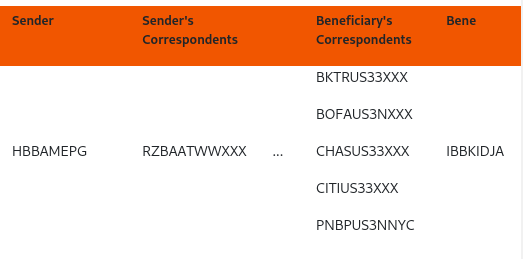
- Route options. Imagine you have wired a payment from Hipotekarna Banka in Montenegro, as on the picture above, to PT Bank Maybank Indonesia. If your bank tells you the transfer is being held at one of the correspondents on the route, the list of alternatives lets you specify a different intermediary for the next attempt, for example CHASUS33.
- Make an assumption on where your payment stuck. If you have any inputs from the tracking system, for example, the status in JPM Chase is “Settled” for the payment above, you can assume it is in the beneficiary's bank already. So beneficiary must take MT103 form together with all documents supporting the payment and go to his bank to speed up the compliance.
How to Get Access to Payment Route Analysis?
Right after your tracking results, a "Route Analysis" button appears on the results page. You can run it either using Credits or with a PRO subscription and higher plans. So simply start tracking your payment and open Route Analysis from the results.