A company paid in USDT for an export, or asked to pay a supplier in it, usually does what it would do with a bank payment: it checks the other side against the sanctions lists. With a wallet address in hand, that means two questions. Is the address on a list, and is the money in it frozen? The second is answered by Tether, the issuer, which can freeze the USDT at any address in the token contract itself. We set the lists' own records beside the contract's, one designation at a time, and the two follow a rule the announcements do not state: Tether freezes the addresses a list prints, not the platform it names.
When the UK sanctioned Xinbi, a crypto marketplace serving scam centres in Southeast Asia, it printed two of its TRON addresses. Tether froze those two the next day. The 50 other Xinbi wallets that the US printed in September were frozen only the day before, and in the five and a half months between, they sent at least 1.5 billion USDT on to other addresses.
Xinbi: two addresses printed, two frozen
The UK designated Xinbi Company Limited on 26 March 2026 under its global human rights regime, with an asset freeze. Its announcement said the sanctions would isolate the platform from the legitimate crypto ecosystem by "affecting its ability to send and receive cryptocurrency transactions". The sanctions notice of that day printed two TRON addresses for it. The USDT contract on TRON records both as frozen on 27 March, in the evening, and none of the 50 others that OFAC would print in September.
On 8 September, from 08:00 UTC, 50 further addresses were frozen. On 9 September the US Treasury designated Xinbi Guarantee as a transnational criminal organisation, and OFAC's entry printed 52 TRON addresses: the two from March and the 50 frozen the day before. The UK updated its own entry the same day, and it now prints 40 of them. Between the UK designation and the September freeze, 39 of those 50 wallets sent at least 1.5 billion USDT, in more than 140,000 transfers, to addresses outside the 52.
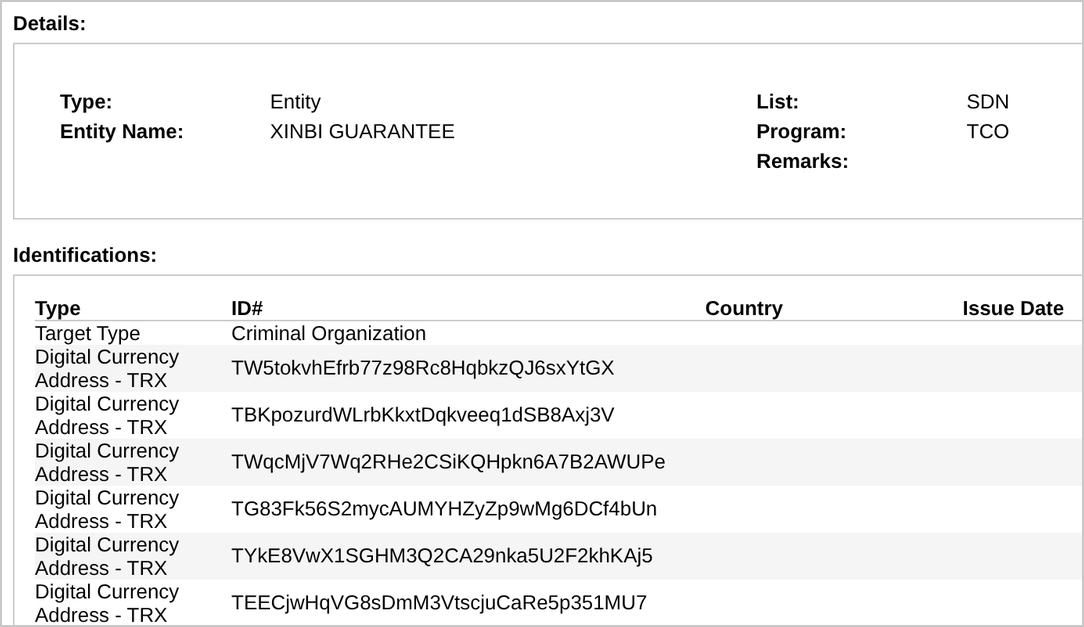
The September freeze was reported at the time, by Decrypt among others. That the March freeze covered exactly what the UK had printed, and nothing else, was not.
Why the US list and the freeze move together
Tether's own policy, in force since December 2023, is to freeze the addresses on OFAC's SDN list, including new additions. It names no other list. The records show the freeze working ahead of the list: of the 140 TRON addresses OFAC has printed for owners designated since January 2024, 67 were frozen before the designation was published and 56 on the same day. Zedcex Exchange, designated on 30 January 2026, had all seven of its TRON addresses frozen between 20 June and 2 July 2025.
TRON addresses OFAC printed for owners designated since January 2024, by when Tether froze them
Before the designation: 67 addresses
On the day: 56 addresses
After it: 17 addresses
US law now points the same way for the stablecoins it covers: the GENIUS Act of July 2025 lets an issuer issue only if it can comply with a lawful order to "seize, freeze, burn, or prevent the transfer" of its coins, and asks the Treasury to coordinate with the issuer before it blocks.
A UK or EU listing reaches the token later
Where only the UK or the EU printed an address, the freeze came after the listing, by one day to two weeks. The EU's February 2025 listing of Garantex printed one TRON address, frozen the next day. The UK's October 2025 listing of Byex Exchange printed two TRON and two Ethereum addresses, frozen three days later. The UK listed EXMO Exchange on 26 May 2026 with three TRON addresses, and Tether froze them on 8 June. In between, one of the three received 585,549 USDT and sent 551,365 USDT in 391 transfers.
For a company bound by UK or EU sanctions, that is the gap that matters. An address on the UK list is listed from the day of the notice, whether or not its money has been frozen. And a wallet of a platform the UK names, but whose address it does not print, is on no list and frozen by nobody, as Xinbi's 50 were for five and a half months.
The lists print few addresses, the freezes run to thousands
| List | Wallet addresses printed | Of them on TRON |
|---|---|---|
| OFAC SDN list (US) | 1,065 | 353 |
| UK sanctions list | 59, on 6 entries | 49 |
| EU consolidated list | 9, on 2 entries | 4 |
| Tether's freezes (not a sanctions list) | 11,284 frozen today, TRON and Ethereum | 8,383 |
That most frozen addresses are on no OFAC entry has been published before: an audit of Tether's freeze list to August 2026 found 180 of 11,045 frozen addresses on OFAC's list. Set against every list and order at once (OFAC's, the UK's and the EU's lists, Israel's seizure orders and the FBI's theft notices), 7,389 of the 8,383 TRON addresses frozen today are on none of them. A freeze carries no name and no published reason: the contract records the address and the time. Tether froze 4,031 TRON addresses in the first eleven months of 2026, more than in all of 2025, and lifted 715 freezes, against 210 in 2025.
What a freeze does to a payment
A frozen address cannot send its USDT. The money stays where it is until Tether lifts the freeze, so a payer whose address is frozen cannot pay you at all.
A frozen address can still receive. Of the 59 frozen addresses of Xinbi Guarantee and Zedcex Exchange, 12 received USDT after their freeze, including three transfers of more than 1,000 USDT each. A payment sent to a frozen address arrives and stays there: the supplier cannot use it, and it moves again only if Tether lifts the freeze.
Before you accept USDT, or send it
- Check the address against the lists and against Tether's freezes, both. The UK list named EXMO's address 13 days before its money was frozen; Tether froze 50 Xinbi wallets a day before any list printed them.
- When the platform behind a payer is sanctioned by name, an address check is not enough. Look at where the payer's money came from, one or two transfers back: a wallet the list does not print shows up only in the money trail.
- Check the address you are paying on the day you pay, not on the day the supplier sent it: a freeze can land in between.
- Keep the dates. Money that reached a wallet before a designation or a freeze is a fact for your file. A transfer after it is a reason to stop and ask.
On Ohmyfin, a wallet address typed into the sanctions check is compared with the official lists and with Tether's freezes, each with its date, and the money it received is followed back to its sources.