What is UETR? Complete Guide to Unique End-to-End Transaction Reference

If you have ever sent or received an international wire transfer, you may have come across a 36-character code called a UETR. Standing for Unique End-to-End Transaction Reference, this identifier has become the backbone of modern cross-border payment tracking. Whether you are a treasury professional reconciling hundreds of daily transactions, a compliance officer auditing payment flows, or an individual waiting for funds to arrive, understanding UETR is essential.

In this comprehensive guide, we explain what a UETR is, where to find it, how it differs from other payment references, and how it enables real-time tracking of SWIFT payments across the global banking network.

What is UETR?

A UETR (Unique End-to-End Transaction Reference) is a universally unique 36-character identifier assigned to every cross-border SWIFT payment message. It follows the payment from the moment the originating bank creates it until the funds are credited to the beneficiary's account, passing unchanged through every intermediary bank along the way.

Think of a UETR as a tracking number for your international wire transfer — similar to how a courier tracking number follows a parcel from sender to receiver, the UETR follows your money across the SWIFT network.

Here is a real example of a UETR code:

de2da6c9-18be-48d4-8053-867ed90a316a

Key facts about UETR:

UETR Format Breakdown

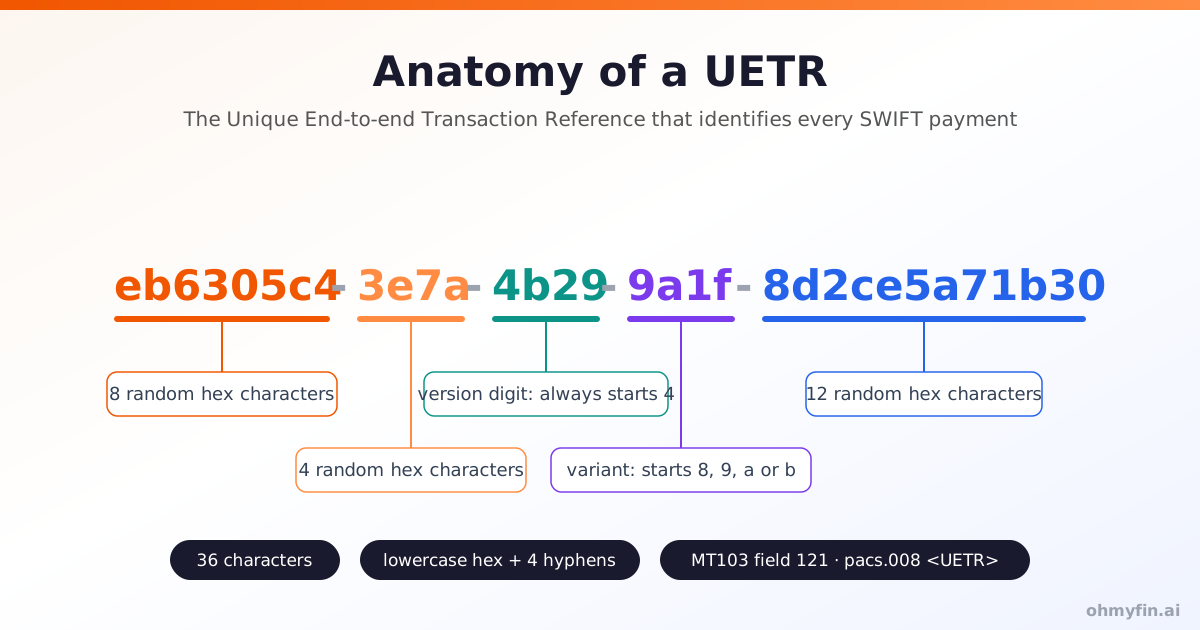
A UETR follows the UUID version 4 format defined by RFC 4122. It consists of 32 hexadecimal characters displayed in five groups separated by hyphens, totalling 36 characters:

xxxxxxxx-xxxx-4xxx-yxxx-xxxxxxxxxxxx

Where:

Breaking down the example de2da6c9-18be-48d4-8053-867ed90a316a:

Segment Value Characters Description
1st group de2da6c9 8 Random hex
2nd group 18be 4 Random hex
3rd group 48d4 4 Starts with 4 (version)
4th group 8053 4 Starts with 8 (variant 8/9/a/b)
5th group 867ed90a316a 12 Random hex

This format produces approximately 5.3 × 1036 possible combinations, making collisions virtually impossible.

Where to Find Your UETR

Locating your UETR depends on the type of payment message and the documents your bank provides. Here are the most common places to look:

In an MT103 message

In a traditional SWIFT MT103 message, the UETR is carried in Field 121 within Block 3 (the User Header Block) of the FIN message. It is not visible in the main text body of the MT103 but appears in the message header metadata. If your bank provides the full MT103 including headers, look for field tag {121:} followed by the 36-character UUID.

For detailed field-by-field breakdowns, see our examples of SWIFT MT103 forms.

In ISO 20022 (pacs.008) messages

In the newer ISO 20022 format that has been replacing MT103 since November 2025, the UETR appears in the <UETR> XML element within the <GrpHdr> (Group Header) section of the pacs.008 message. It is more prominently placed and easier to locate than in legacy MT messages.

In bank payment confirmations

Most banks now include the UETR on payment confirmation receipts, online banking transaction details, and SWIFT copy documents. It may be labelled as:

If you cannot find the UETR in your documents, contact your bank and request the UETR number associated with your payment. Every SWIFT transfer processed since November 2018 must have one.

In bank statements

Some banks include the UETR in electronic bank statements (MT940/MT950 or camt.053). However, this is not universal — many banks still only show the Transaction Reference Number (TRN) in statement entries. If the UETR is not on your statement, request it from your bank's operations or payments team.

UETR vs TRN vs Other Payment References

International payments carry several reference numbers, and it is easy to confuse them. Here is how the UETR compares to other common identifiers:

Feature UETR TRN (Transaction Reference Number) Sender's Reference (Field 20)
Full name Unique End-to-End Transaction Reference Transaction Reference Number Sender's Reference
Format 36-char UUID v4 Up to 16 alphanumeric characters Up to 16 alphanumeric characters
Example de2da6c9-18be-48d4-8053-867ed90a316a FT24089ABCDE PAYMENT-2024-001
Uniqueness Globally unique (guaranteed) Unique within originating bank Unique within originating bank
Mandatory Yes (since Nov 2018) Yes Yes
Location in MT103 Block 3, field 121 Block 4, field 20 Block 4, field 20
End-to-end tracking Yes — tracked across all banks in the chain Partial — may change at intermediary banks No — only relevant to the originator
GPI Tracker support Full real-time tracking Limited (best-effort lookup) Not trackable
Assigned by Originating bank (system-generated) Originating bank (system-generated) Sender or originating bank

Key takeaway: The UETR is the only reference that remains constant and trackable across the entire payment chain. The TRN, while useful, may be modified by intermediary banks and does not provide the same end-to-end visibility. If you need to track a payment using a TRN, results may be limited compared to UETR-based tracking.

How to Track a Payment Using UETR

Once you have your UETR, tracking your international wire transfer is straightforward. Follow these steps:

Step 1: Obtain the UETR

Locate the UETR from your payment confirmation, MT103 copy, or by requesting it from your bank. Verify it is a valid 36-character UUID in the format described above.

Step 2: Use a SWIFT GPI tracking service

Enter your UETR into a GPI-enabled tracking tool. These services query the SWIFT GPI network to retrieve the current status of your payment, including which banks have processed it and when.

Step 3: Interpret the status

The tracking result will show one or more GPI status codes indicating the payment's current state. The most common statuses are:

Step 4: Follow up if needed

If the status shows ACSP for an extended period, contact your bank with the UETR and ask them to investigate through SWIFT's gpi case resolution service. The UETR gives your bank's operations team a precise reference to trace the payment across the correspondent banking chain.

When UETR Tracking Does Not Work

While UETR tracking is powerful, there are scenarios where it has limitations or does not apply:

Domestic transfers

UETR is a SWIFT network feature. Domestic payment systems such as Fedwire (US), SEPA (Europe), Faster Payments (UK), or RTGS (India) use their own reference formats. If your transfer stays within a single country's payment infrastructure, there will be no UETR. Note, however, that since the US Fedwire system migrated to ISO 20022 in March 2025, some domestic US payments now carry a UETR-like identifier.

Pre-November 2018 payments

UETR became mandatory in November 2018. Payments sent before this date may not have a UETR, or may have one that was not reported to SWIFT's tracking infrastructure.

Non-GPI banks

While over 4,000 institutions participate in SWIFT GPI, some smaller or regional banks may not yet report status updates against the UETR. In these cases, tracking may show incomplete information, with status updates missing from certain legs of the payment journey.

Payment networks outside SWIFT

Transfers sent through alternative networks such as Ripple, Wise (TransferWise), or other fintech payment rails do not use SWIFT UETR. These services have their own tracking mechanisms.

Cover payments (MT202 COV)

In some correspondent banking arrangements, a customer payment (MT103) is accompanied by a separate cover payment (MT202 COV). Both messages carry the same UETR, but tracking visibility may vary depending on which banks in the chain report status updates for the cover leg.

Which SWIFT Message Types Require UETR?

UETR is mandatory in several SWIFT message types. With the ongoing migration to ISO 20022, the following message types carry a UETR:

ISO 20022 messages (current standard)

Legacy MT messages (still in use during transition)

SWIFT's coexistence period allows both MT and ISO 20022 messages to carry the UETR, ensuring tracking continuity during the migration.

ISO 20022 and the Future of UETR

The global financial industry is in the midst of a major messaging transition. Since November 2025, SWIFT has enabled ISO 20022 as the primary standard for cross-border payments, with the pacs.008 message gradually replacing the legacy MT103.

What this means for UETR:

The UETR is not going away — it is becoming more important as the financial industry moves to richer, more structured payment messaging.

Frequently Asked Questions

What does UETR stand for?

UETR stands for Unique End-to-End Transaction Reference. It is a globally unique identifier assigned to every SWIFT cross-border payment message. The name reflects its purpose: it uniquely identifies a transaction from end to end, across all banks in the payment chain.

How many characters is a UETR?

A UETR is exactly 36 characters long, consisting of 32 hexadecimal characters arranged in five groups separated by four hyphens. The format follows the UUID version 4 standard (e.g., de2da6c9-18be-48d4-8053-867ed90a316a).

When did UETR become mandatory?

SWIFT made UETR mandatory for all cross-border customer credit transfers (MT103) and financial institution transfers (MT202) in November 2018. Since then, every SWIFT payment must carry a UETR generated by the originating bank.

Can I track a payment with just a UETR?

Yes. The UETR is the most effective reference for tracking a SWIFT payment. Because it is globally unique and remains unchanged across all intermediary banks, it provides the most reliable way to query the SWIFT GPI tracking system for real-time payment status.

What is the difference between UETR and TRN?

The TRN (Transaction Reference Number) is a bank-assigned reference of up to 16 characters that may change as the payment passes through intermediary banks. The UETR, by contrast, is a 36-character globally unique identifier that never changes throughout the payment's lifecycle. UETR provides end-to-end tracking; TRN provides partial tracking at best.

Where is the UETR in an MT103?

In a legacy MT103 message, the UETR is located in Block 3 (User Header Block), field 121. It is not part of the main message body (Block 4) but rather part of the message metadata. Not all bank-provided MT103 copies include Block 3, so you may need to request the full message from your bank.

Does every SWIFT payment have a UETR?

Every SWIFT payment sent since November 2018 must have a UETR. If a payment message arrives at SWIFT without a UETR, SWIFT's infrastructure will assign one automatically. In practice, this means all cross-border SWIFT payments in the network today carry a UETR.

Can two payments have the same UETR?

No. The UUID v4 format used for UETR generates identifiers from a pool of approximately 5.3 × 1036 possible values. The probability of two payments receiving the same UETR is vanishingly small, effectively zero for all practical purposes.

Is UETR the same as an end-to-end ID?

They are related but not identical. In ISO 20022 messages, the End-to-End Identification (EndToEndId) is a reference assigned by the originating customer, while the UETR is a system-generated UUID assigned by the originating bank. Both travel with the payment end-to-end, but the UETR is the one used for SWIFT GPI tracking.

My bank cannot find my payment using the UETR. What should I do?

If your bank's SWIFT GPI query returns no results for your UETR, consider the following: (1) verify the UETR is correct and complete (all 36 characters including hyphens), (2) confirm the payment was actually sent via SWIFT and not a domestic payment system, (3) check whether the payment was sent before November 2018, and (4) ask your bank to escalate through SWIFT's gpi case resolution service, which can investigate payments across the entire chain using the UETR.


Track Your SWIFT Payments

Create a free account to track international wire transfers and get real-time status updates.